

When buyers compare concrete batching plants, the purchase price often becomes the main focus. A lower quotation looks attractive. It seems like a smart way to save money.
But the purchase price is only one part of the total cost. Over five years of operation, a cheaper plant can become more expensive than a higher-priced alternative. This article breaks down the total cost of ownership (TCO) across five key areas.
What Is TCO and Why It Matters
TCO stands for Total Cost of Ownership. It includes all costs linked to owning and operating a plant over its service life. These costs go beyond the initial purchase.
Life Cycle Cost (LCC) management follows a similar principle. It looks at the true cost of an investment from acquisition to disposal. For batching plants, this approach reveals costs that are not visible on the quotation sheet.
A plant with a low price tag may carry higher operating costs, more frequent breakdowns, and lower resale value. These factors change the real cost picture within a few years.
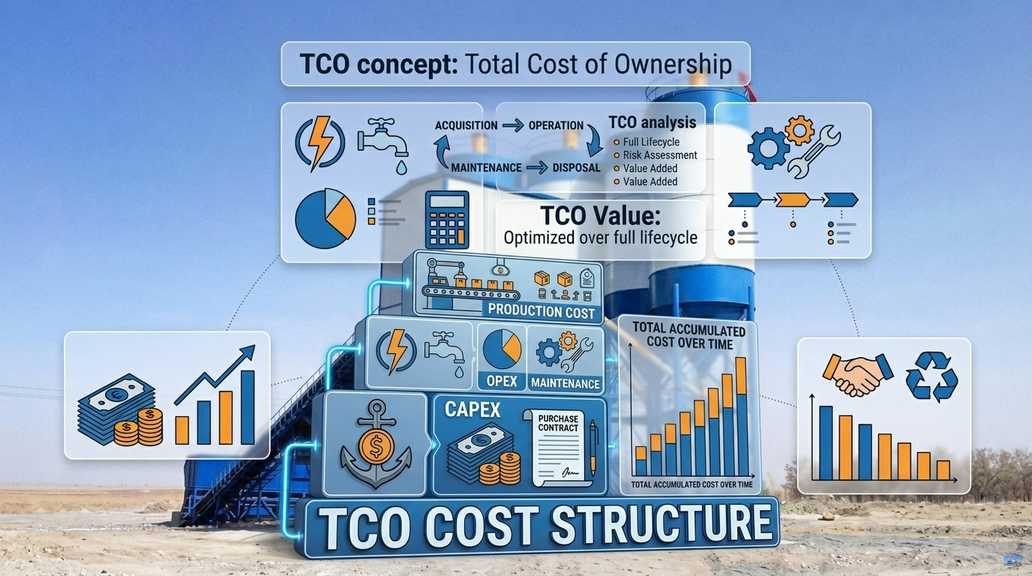
The Five Main Cost Components
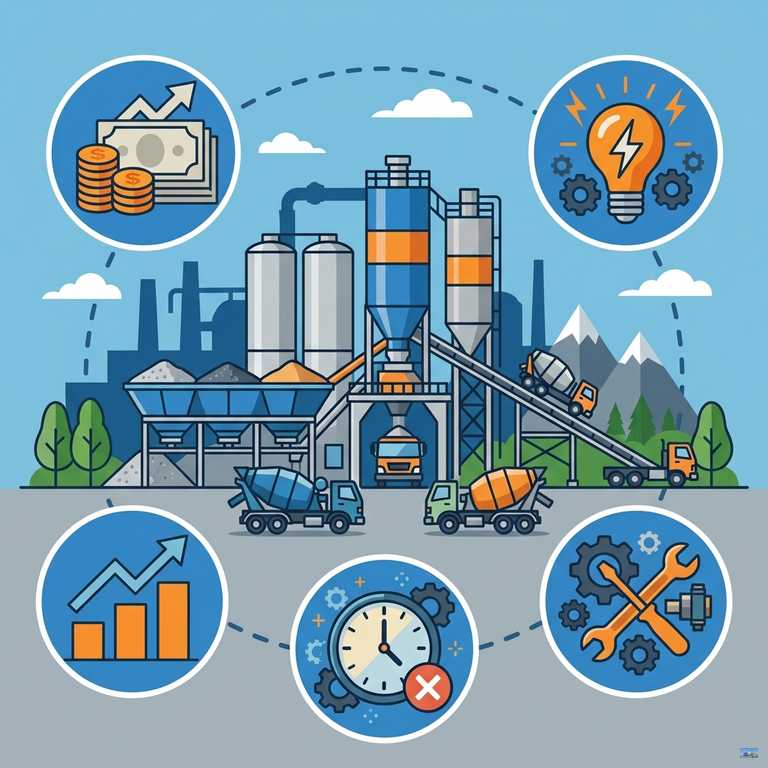
TCO for a concrete batching plant can be divided into five parts, The sections below explain how each component differs between low-cost and higher-quality plants.
Initial purchase cost
equipment price, freight, installation, commissioning
01
Energy cost
power consumption per cubic meter produced
02
Maintenance and repair cost
wear parts, scheduled service, unexpected repairs
03
Downtime cost
lost production and delayed deliveries
04
Residual value
resale or trade-in value after five years
05
1. Initial Purchase Cost
-
This is the most visible cost. It includes the plant itself, transportation, and setup.
-
Equipment prices vary widely by capacity. A small plant (25–50 m³/h) may cost between $80,000 and $180,000. A medium plant (60–90 m³/h) ranges from $100,000 to $500,000. Large plants above 150 m³/h can exceed $800,000.
Installation and site work add more. For a stationary plant, civil work, electrical connections, and commissioning can run from $30,000 to $150,000.
-
A low-priced plant may seem to save money here. But the savings often come from reduced specifications or lower-grade components. These differences show up later.
2. Energy Cost
Power consumption is a major operating expense. It often accounts for 15–25% of total operating costs.
The mixer is the largest power consumer. A twin-shaft mixer on a medium plant may draw 2×55 kW or more. Conveyors, compressors, and control systems add to the load.
Low-cost plants may use less efficient motors or undersized drives. These components consume more electricity per cubic meter. The difference may seem small per hour. Over five years, it becomes significant.
3. Maintenance and Repair
Maintenance costs are often underestimated at the time of purchase. For used plants, annual maintenance can reach 5–10% of the purchase price. For new plants, it is typically 2–5%.
The reasons are straightforward. Mixer liners, arms, and shafts wear under abrasion. Conveyor belts need replacement every 3–7 years. Control system components age and require updates.
A low-cost plant may use thinner steel, lower-grade wear parts, or off-brand electrical components. These choices reduce the upfront price but increase the frequency and cost of replacements.
4. Downtime Cost
Downtime is the most damaging cost. When a plant stops, production stops. Deliveries are delayed. Customers lose confidence.
The cost of downtime depends on production volume and profit per cubic meter. A plant producing 100 m³ per day with a profit of $10 per m³ loses $1,000 per day of downtime. A week of downtime costs $7,000.
Low-cost plants have a higher risk of unexpected failures. Used equipment often shows hidden wear in mixers, weighing systems, and electrical controls. Repairs take time. Parts may not be readily available.
5. Residual Value
After five years, a plant still has value. But that value depends on brand, condition, and market demand.
Well-maintained plants from established brands hold their value better. Buyers pay a premium for equipment with service records and available parts support. A used plant from a known brand can sell for 30–60% less than new, depending on age and condition.
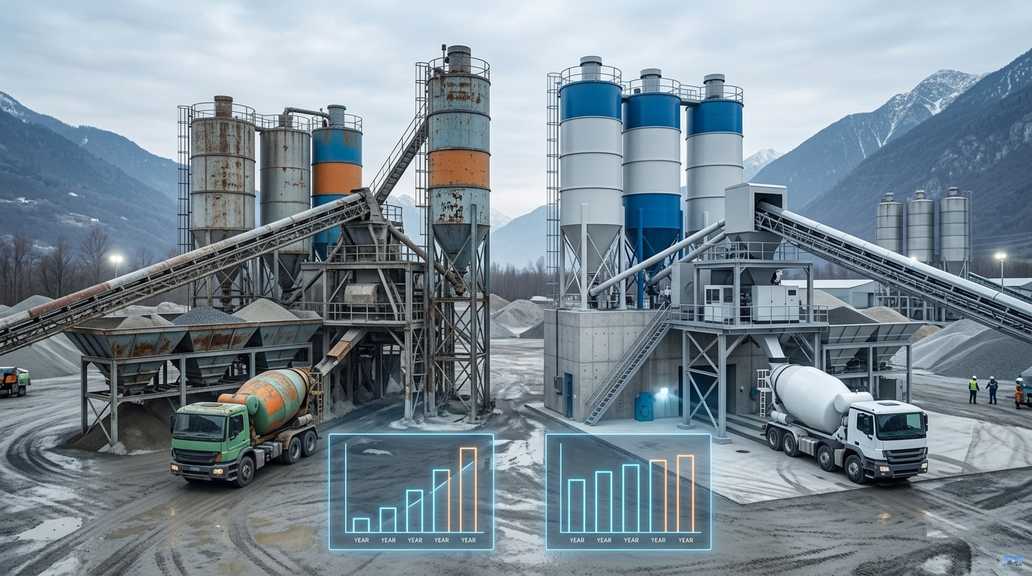
Off-brand or poorly maintained plants sell at a discount. The pool of buyers is smaller. Parts availability is uncertain. Sellers often accept lower offers to close a deal.
A Side-by-Side Comparison
The table below shows how two plants with different purchase prices compare over five years. The figures are estimates for a medium-capacity stationary plant (60–90 m³/h).
| Cost Component | Low-Cost Plant | Higher-Quality Plant |
|---|---|---|
| Purchase price | $180,000 | $280,000 |
| Installation and site work | $40,000 | $45,000 |
| Annual energy cost | $18,000 | $14,000 |
| Annual maintenance | $14,000 | $7,000 |
| Downtime (annual estimate) | $8,000 | $2,000 |
| Resale value after 5 years | $50,000 | $110,000 |
| Total 5-year cost | $380,000 | $341,000 |
The low-cost plant saves $100,000 at the start. But higher energy use, more maintenance, and greater downtime add up over five years. The resale value is also lower. The total cost ends up higher.
What to Check Before Buying
Buyers can protect themselves by asking specific questions
Energy rating of motors and drives - request efficiency data
Wear part specifications - steel grade, thickness, and supplier
Control system age and upgrade path - avoid obsolete proprietary systems
Parts availability - can parts be sourced locally or only from the factory?
Service records - for used plants, request full maintenance history
Batching accuracy - aggregate ±2%, cement and water ±1% is a common industry standard. These details matter more than the purchase price alone.
Conclusion
The cheapest batching plant is not always the most economical choice. A low purchase price often leads to higher costs in other areas: energy, maintenance, downtime, and lower resale value.
A five-year TCO analysis shows the real cost picture. Buyers who look beyond the quotation sheet can avoid the hidden cost of cheap equipment.


