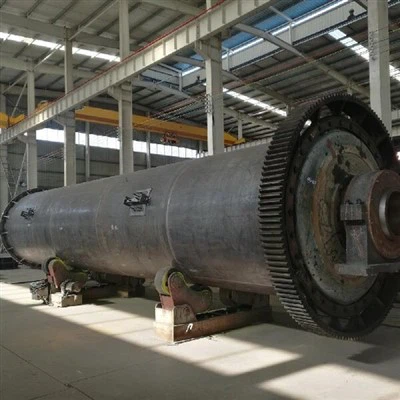
As a trusted supplier of rotary kiln parts, I often get inquiries from customers about how to calculate the power consumption of these parts. Understanding the power consumption is crucial for optimizing the operation of rotary kilns, reducing energy costs, and ensuring the long - term reliability of the equipment. In this blog post, I'll share some key methods and considerations for calculating the power consumption of various rotary kiln parts.
1. Understanding the Basics of Power Consumption in Rotary Kilns
Before diving into the specific parts, it's important to understand the fundamental factors that contribute to power consumption in a rotary kiln. The main factors include the weight of the kiln and its contents, the rotational speed, the friction between moving parts, and the efficiency of the drive system.
The power required to rotate a kiln can be estimated using the following basic formula:
[P = \frac{T\times\omega}{1000}]
where (P) is the power in kilowatts (kW), (T) is the torque in Newton - meters (N·m), and (\omega) is the angular velocity in radians per second (rad/s).
2. Calculating Power Consumption for Specific Rotary Kiln Parts
Kiln Girth Gear
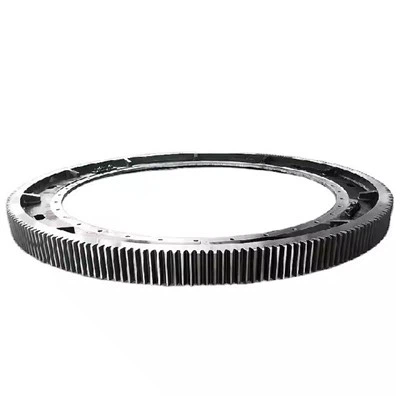
The Kiln Girth Gear is a critical component in the rotary kiln drive system. It transfers the power from the drive motor to the kiln shell, enabling rotation. To calculate the power consumption related to the girth gear, we need to consider the following:
- Torque Transmission: The torque required to rotate the kiln is transmitted through the girth gear. The torque on the girth gear can be calculated based on the kiln's load and the gear ratio. If we know the total torque (T) required to rotate the kiln and the efficiency (\eta) of the gear system, the power consumed by the girth gear (P_{girth}) can be calculated as:
[P_{girth}=\frac{T\times\omega}{\eta\times1000}]
The efficiency (\eta) of the girth gear system is affected by factors such as gear tooth profile, lubrication, and alignment. A well - maintained and properly aligned girth gear system can have an efficiency of around 95% - 98%.
- Friction Losses: There are frictional losses in the gear teeth due to the meshing action. These losses can be estimated based on the coefficient of friction (\mu), the normal force (F_n) between the gear teeth, and the relative sliding velocity (v). The power loss due to friction (P_{friction}) is given by:
[P_{friction}=\mu\times F_n\times v]
To calculate (F_n), we need to consider the tangential force transmitted by the gear, which is related to the torque.
Rotary Kiln Seal
The Rotary Kiln Seal is used to prevent air leakage in and out of the kiln, which is important for maintaining the proper combustion environment and energy efficiency. Although the seal itself doesn't consume a large amount of power directly, its performance can affect the overall power consumption of the kiln.
- Air Leakage Impact: If the seal is not functioning properly, there will be air leakage. This can lead to an imbalance in the kiln's air - fuel ratio, requiring more fuel to maintain the desired temperature. Additionally, the extra air intake can increase the load on the induced draft fan, which in turn increases the power consumption of the fan.
To estimate the power impact of air leakage, we can use the following steps:
- Measure the air leakage rate (Q) (in cubic meters per second) through the seal.
- Determine the pressure difference (\Delta P) across the leakage path.
- The power required to move the leaked air can be estimated using the fan power formula:
[P_{leakage}=\frac{Q\times\Delta P}{\eta_{fan}}]
where (\eta_{fan}) is the efficiency of the induced draft fan.
- Seal Friction: There is also a small amount of friction between the seal and the kiln shell. This friction can be calculated based on the normal force exerted by the seal on the shell and the coefficient of friction. The power loss due to seal friction (P_{seal - friction}) is given by:
[P_{seal - friction}=F_{seal}\times v_{seal}]
where (F_{seal}) is the normal force of the seal on the shell and (v_{seal}) is the relative velocity between the seal and the shell.
Kiln Thrust Roller
The Kiln Thrust Roller is responsible for supporting the axial load of the kiln and guiding its movement. To calculate the power consumption related to the thrust roller, we consider the following aspects:
- Rolling Resistance: The rolling resistance of the thrust roller is a major factor contributing to power consumption. The rolling resistance force (F_r) can be calculated using the formula:
[F_r = C_r\times W]
where (C_r) is the coefficient of rolling resistance and (W) is the axial load on the thrust roller.
The power consumed by the thrust roller (P_{thrust}) due to rolling resistance is:
[P_{thrust}=F_r\times v_{roller}]
where (v_{roller}) is the linear velocity of the roller surface.
- Bearing Friction: The bearings in the thrust roller also contribute to power consumption. The power loss due to bearing friction (P_{bearing}) can be estimated based on the bearing type, load, and rotational speed. For a ball bearing, the power loss formula is more complex and depends on factors such as the bearing size, lubrication, and load distribution.
3. Other Considerations for Power Consumption Calculation
-
Temperature Effects: The power consumption of rotary kiln parts can be affected by temperature. High temperatures can change the material properties, such as the viscosity of lubricants and the coefficient of friction. For example, at high temperatures, the lubricant may become thinner, reducing its ability to reduce friction, which can increase power consumption.
-
Maintenance and Wear: The condition of the parts also plays a significant role. Worn - out parts, such as gears with excessive tooth wear or seals with damaged surfaces, can lead to increased friction and power consumption. Regular maintenance, including lubrication, alignment checks, and part replacement, is essential to keep the power consumption at an optimal level.
4. Importance of Accurate Power Consumption Calculation
Accurately calculating the power consumption of rotary kiln parts has several benefits:
-
Cost Savings: By understanding the power consumption of each part, operators can identify areas where energy can be saved. For example, improving the seal performance or optimizing the gear system can lead to significant energy cost reductions.
-
Equipment Optimization: It helps in the design and selection of the appropriate parts. For instance, if the power consumption of a particular girth gear is too high, a more efficient gear design or a different gear material can be considered.


-
Predictive Maintenance: Monitoring the power consumption of parts over time can help in detecting early signs of wear or malfunction. An increase in power consumption may indicate a problem with a part, such as a misaligned gear or a leaking seal, allowing for timely maintenance.
5. Conclusion and Call to Action
Calculating the power consumption of rotary kiln parts is a complex but essential task for optimizing the operation of rotary kilns. As a rotary kiln parts supplier, we are committed to providing high - quality parts that not only meet the performance requirements but also contribute to energy efficiency.
If you are looking for reliable rotary kiln parts and need more information on power consumption or any other technical aspects, we are here to help. Our team of experts can assist you in selecting the right parts for your specific application and provide guidance on optimizing your kiln's energy consumption. Contact us for a detailed consultation and let's work together to improve the efficiency and reliability of your rotary kiln.
References
- "Rotary Kiln Technology Handbook" by Peter K. Sear.
- "Mechanical Design of Machine Elements and Machines: A Failure - Prevention Perspective" by Robert C. Juvinall and Kurt M. Marshek.
- Industry standards and guidelines related to rotary kiln operation and maintenance.