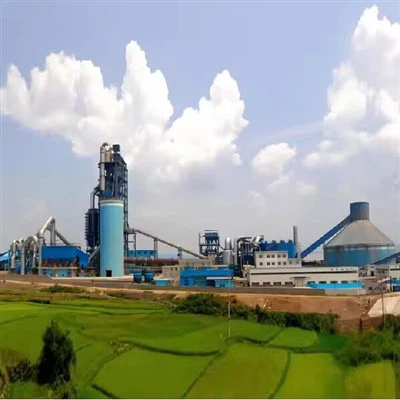
Product Description
A Plant Sized Around Finished Cement
AGICO's 10000 tpd cement plant is an integrated dry-process production system for a finished cement target of 10,000 tonnes per day. Raw-material preparation, clinker burning, cement grinding, and dispatch are planned as connected systems. Clinker demand is calculated from the cement recipe, while grinding capacity is sized for the available operating hours and required fineness. AGICO combines process engineering with equipment supply to match these production requirements and site conditions.

10,000
t/d
Finished cement target
416.7
t/h
24-hour net grinding case
500
t/h
20-hour net grinding case
1,450
°C
Approximate clinker formation
Product Advantages
Capacity Matched Across Production Stages
AGICO's plant design links the cement sales target with clinker demand, grinding duty, storage, and dispatch planning.
Grinding Selected for Cement Recipes
AGICO's grinding systems are selected around clinker grindability, mineral additions, moisture, and target product fineness.
Heat Recovery Within the Process
The clinker cooling system of AGICO CEMENT returns recovered heat to the burning process through coordinated air connections.
Engineering Built Around Site Conditions
AGICO's engineering scope coordinates equipment arrangement, material routes, utilities, and maintenance access within the available site.
Working Process

1
Raw Meal Preparation
Limestone and corrective materials are crushed, proportioned, ground, and homogenized.
2
Preheating and Clinker Burning
Raw meal passes through preheating and calcination before clinker is formed in the rotary kiln.
3
Cooling and Cement Grinding
Cooled clinker is stored, then ground with gypsum and selected mineral additions.
4
Storage and Dispatch
Finished cement is collected in silos for dispatch.
Plant Configuration

Kiln and Cooling System
The preheater, calciner, rotary kiln, and clinker cooler are sized together for the required clinker production.

Cement Grinding Circuits
Ball-mill or vertical-mill circuits are selected for the cement mix and combined hourly grinding duty.

Storage and Dispatch Interfaces
Clinker and cement storage connect continuous production with the planned packing and bulk-loading schedule.
Hot Tags: 10000 tpd cement plant, China 10000 tpd cement plant manufacturers, factory, ball mill cement machine, cement factory working process, cement manufacturing, cement manufacturing steps, manufacture of ordinary portland cement, manufacturing process of white cement
Technical Parameters
| Parameter | Value or configuration | Engineering use |
|---|---|---|
| Finished cement target | 10,000 t/d | Total across the cement product mix |
| Continuous grinding planning case | 24 net operating h/d | Net grinding hours for this case |
| Combined grinding output at 24 h/d | 416.7 t/h | 10,000 / 24; all running circuits |
| Reduced-hour grinding planning case | 20 net operating h/d | Alternative net grinding hours |
| Combined grinding output at 20 h/d | 500 t/h | 10,000 / 20; all running circuits |
| Clinker formation temperature | Approximately 1,450 °C | Material in the kiln burning zone |
| Production route | Dry process with preheating and precalcination | Raw meal through clinker cooling |
| Cement grinding options | Ball-mill or vertical-mill circuits | Recipe, grindability and fineness |
Final plant parameters are determined by raw materials, cement output, process requirements, customization, and site conditions. Contact AGICO's professional team for a project-specific configuration.
Request a Cement Plant Proposal
FAQ
Does 10,000 t/d mean clinker output?
+
-
No. This page uses 10,000 t/d as finished cement output. AGICO calculates clinker demand from the clinker proportion in each cement recipe and the production schedule. The kiln and cement mills are therefore sized on separate material balances.
Should the plant use one large cement mill or several circuits?
+
-
AGICO compares the required hourly output, cement grades, available operating time, and maintenance schedule. Separate circuits can serve different products or operating schedules. Mill number and size follow the selected production plan.
What information is needed for a plant proposal?
+
-
Send AGICO raw-material analyses, fuel data, cement types and standards, target fineness, daily output, operating schedule, site drawings, and utility conditions. These inputs support the process balance and equipment selection.
What determines storage and dispatch capacity?
+
-
AGICO reviews cement-grade separation, dispatch hours, bulk and bagged demand, and transport arrangements. Storage and loading equipment are selected to connect production with the planned shipment schedule.