

Kiln Overview
What Does 100 TPD Mean?
A 100 TPD rotary kiln is a rotating thermal-processing unit selected for a daily material target of 100 metric tonnes. Its steel cylinder turns slowly on support rollers. A slight slope helps the moving bed travel from the feed end toward the discharge end. Heat changes the material through calcination or another planned reaction.
The first buying question is what the daily figure measures. Feed entering the kiln and saleable product leaving the line are different quantities. Limestone, for example, releases carbon dioxide when it becomes quicklime. Moisture removal also changes the mass balance.
At 24 operating hours, 100 t/day equals about 4.17 t/h on the same mass basis. At 20 hours, the required average becomes 5 t/h. Planned stops, product losses and feed variation should be included when the line is sized.
The linked 100 TPD rotary kiln page introduces a compact system and its equipment data. This guide looks more closely at the process, installation interfaces and purchasing decisions behind that daily target.

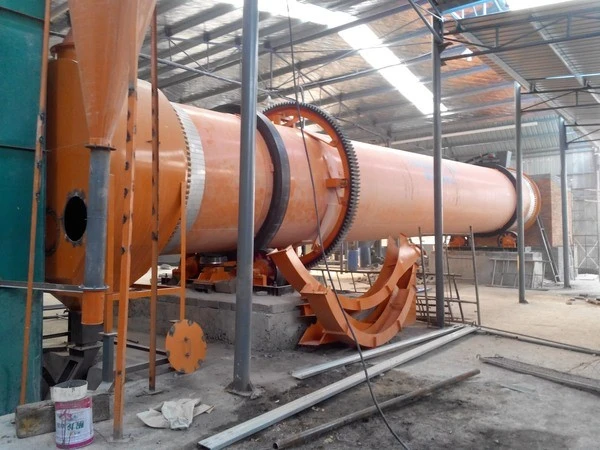
A rotary kiln, support piers and adjoining process structures.
Technical Details
Read the Equipment Data Correctly
Diameter and length describe the kiln body. They do not describe the complete installed plant. Space is also needed for feeding, the burner, cooling, gas treatment, access and lifting.
The linked configuration gives the following equipment data. The 3–6 t/h range describes kiln-body throughput; it should be read alongside the material and production basis.
| Diameter (m) | Length (m) | Rate (t/h) | Drive (kW) | Weight (t) | Reducer | Ratio |
|---|---|---|---|---|---|---|
| 2.5 | 40 | 3–6 | 55 | Approx. 145 | AGZS125 | 63.1 |
The main drive turns the kiln. Its 55 kW rating is not the electrical demand of the complete line. Fans, feeders, conveyors, fuel preparation and cooling equipment add separate loads. Likewise, the reducer ratio alone does not establish the kiln's operating speed.
The related 100 TPD kiln page lists an AG24 configuration with 4–5 t/h capacity and a 55 kW motor. Keep the two equipment schedules separate when comparing quotations.
Final equipment dimensions and operating parameters are selected from the material, required output, process route and site conditions.
Understand the Structural Assembly
The assembly illustration separates the support stations and drive from the shell. Riding rings, also called tyres, carry the shell on rollers. The girth gear receives torque from the pinion and drive unit. The lining inside the cylinder protects the steel from the process heat.

CAD-style assembly illustration showing the shell, riding rings, separated support stations and drive.
Follow the Material and Gas Paths
The flow diagram shows a lime route with a preheater. Screened limestone is fed at a controlled rate. Hot kiln exhaust heats the stone before it enters the rotating cylinder. Rotation turns the bed and brings fresh surfaces into contact with heat.
Inside the reaction zone, calcium carbonate breaks down into calcium oxide and carbon dioxide: CaCO3 → CaO + CO2. Temperature and residence time must work together. Insufficient treatment leaves carbonate in the product; excessive treatment can reduce the reactivity required by the buyer.
Hot lime then enters the cooler. Cooling air takes up product heat, and a selected portion returns to the kiln hood as secondary combustion air. Kiln exhaust travels toward the feed end, transfers heat in the preheater and passes through the selected gas-conditioning and dust-collection system.

Lime process flow showing the solids route, kiln exhaust and recovered cooling air.
Inspect the Main Component Regions
Girth Gear and Main Drive
The girth gear, pinion, reducer and motor transmit torque to the shell. Alignment, tooth contact and lubrication affect their condition. Record changes in drive current, vibration and noise so a developing fault can be investigated early.
Riding Rings and Support Rollers
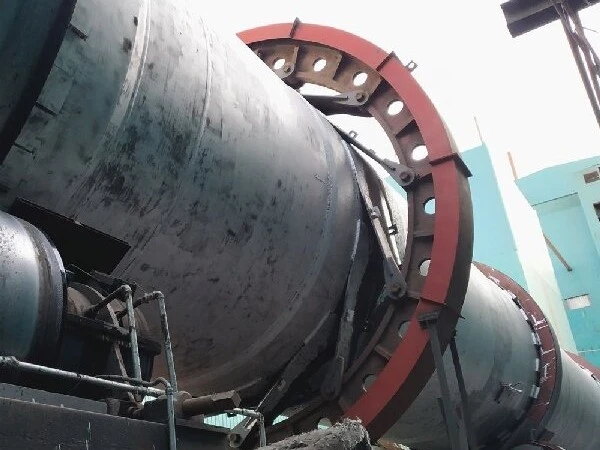
Riding rings and rollers carry the rotating load. The support arrangement also controls axial movement. Uneven contact or changes in bearing temperature deserve attention. Roller adjustments should follow the equipment procedure and measured alignment condition.
Refractory Lining
Refractory is selected for the temperature, chemical exposure and mechanical duty of each zone. Brick shape and installation quality matter as well as the material grade. Cracking, loose lining and unusual shell hot spots can signal a developing problem.


Gas Handling and Dust Control
The exhaust fan, ducts and seals help control pressure and air entry. Dust collection is selected from gas volume, temperature, dust properties and the applicable emission requirements. A bag filter needs suitable inlet conditions. It should not be selected from daily kiln capacity alone.
Applications

Lime Production and a Published Project
Quicklime can serve steelmaking, chemical processing and other industrial uses. Buyers should define available CaO, residual carbonate, reactivity and product size before selecting the thermal system. Feed preparation and cooling are part of that quality task.
A published 600 t/d rotary lime kiln project in Shandong describes limestone preparation, preheating, rotary calcination, cooling and product handling in Qingdao. It is a larger-scale example of connected process stages. A 100 t/d design needs its own equipment sizing and heat balance.
Cement Clinker and Mineral Calcination
Cement raw meal follows a different reaction route from sized limestone. Clinker formation involves several mineral reactions and a material temperature around 1,450°C. Raw-meal preparation, burning conditions and cooling therefore need to be designed for clinker quality.
Magnesite processing provides another use. Light-burned magnesia and dead-burned magnesia require different thermal treatment and final properties. A kiln selected for one duty should not be judged by the output or fuel consumption of another.
For a new project, start with representative material tests and a defined product. For a replacement project, also examine existing feeders, cooling, gas treatment and plot limits. These interfaces can decide whether a small rotary kiln fits the site.

Project Planning
Plan Transport and Site Space Together
A kiln's operating length and its shipping-piece length are different planning dimensions. Obtain a packing list showing each item's dimensions, mass, lifting points and centre of gravity. Check the route from the port or factory to the foundation before heavy equipment is dispatched.
The equipment weight is not the load of one lift. Shell sections, support assemblies and auxiliary packages need individual handling plans. Allow space to assemble components, inspect joints and remove parts during future maintenance.

| Planning item | Data or document | Practical use |
|---|---|---|
| Kiln-body diameter | 2.5 m in the linked configuration | Begin the equipment envelope |
| Kiln-body length | 40 m in the linked configuration | Coordinate the longitudinal layout |
| Equipment weight | Approx. 145 t in the linked configuration | Begin the delivery breakdown |
| Largest shipping piece | Packing dimensions and individual mass | Select vehicles and check the route |
| Foundation and support levels | Approved general arrangement and load drawings | Set out civil works and alignment |
| Lifting and service space | Erection plan and maintenance clearances | Position cranes and access routes |
Build the Installed Cost
Compare quotations against the same equipment and service boundary. A bare kiln price and a complete production-line offer cover different work. A useful budget separates delivery, site construction, commissioning and the stock needed for initial operation.
| Cost item | Scope to include | Main pricing inputs |
|---|---|---|
| Kiln package | Shell, supports, drive, seals and burner | Process duty and supply boundary |
| Process auxiliaries | Feeding, cooling, fans and gas cleaning | Material flow, heat balance and emissions |
| Logistics | Packing, freight, insurance and inland delivery | Shipping pieces, route and delivery terms |
| Civil works | Foundations, steelwork, access and utilities | Soil conditions, loads and site services |
| Erection | Cranes, labour, alignment and assembly | Lift plan, local resources and work scope |
| Commissioning | Checks, first heating, trials and training | Agreed tasks and acceptance procedure |
| Initial stock | Refractory, wear parts and consumables | Maintenance plan and replenishment time |
Request itemized prices in one currency with consistent delivery terms, tax treatment and offer validity. Identify who supplies refractory, site wiring, fuel connections and erection tools. This makes exclusions visible before they become site costs.
Operating cost also needs a common basis. Compare fuel, electricity, labour and maintenance per tonne of saleable product. Feed moisture, product yield, operating hours and heat recovery all affect that figure. Motor nameplate power alone cannot predict it.
Installation and Operation
Align the Kiln Before Heating
Check the foundations, embedded items and survey references against the approved drawings. Install the support assemblies and position the shell sections in the specified sequence. Inspect field joints and complete shell alignment before setting the drive and seals.
Complete the lining, burner, cooler, ducts, lubrication and control connections. Cold checks should cover rotation, direction, clearances, lubrication, instruments, alarms and interlocks. Record the mechanical condition before heat changes the equipment dimensions.

Start Up in Controlled Stages
Follow the refractory supplier's curing and heat-up schedule. Complete the burner and fuel-system checks, establish the required draft and introduce feed under the commissioning procedure. Increase the load in controlled steps while checking product quality and equipment response.
Judge production after the line reaches stable conditions. The acceptance record should define the test duration, material and fuel, measured output, quality results and utility use. A short peak rate does not describe sustained daily production.
Inspect the Running Kiln
Routine rounds should cover bearing temperatures, lubrication, gear condition, seals, shell temperature and unusual sound or vibration. Keep records of feed, fuel, draft, speed and product quality. Trends often explain a change more clearly than an isolated reading.
Plan shutdown inspections around the lining, shell, support stations and drive. Alignment should be reviewed after major component work or signs of uneven loading. Inspecting the kiln and its supporting equipment together helps distinguish a mechanical fault from a feeding or gas-flow problem.

Access walkways beside a rotary kiln shell and support station.
Spare Parts


Plan Supply Before Ordering
Agree on the spare-parts package when the main kiln is purchased. Separate frequently used items from large components with long manufacturing times. Stock decisions should consider failure consequence, replenishment time, storage life and the plant's repair capability.
Ask the supplier to document the warranty, exclusions, technical response arrangements and replacement procedure. Request a part-numbered list with drawings or identification details. Check what is physically stocked, where any regional warehouse is located and how parts will reach the site.
Local stock can shorten a wait, but the exact part and availability matter. Include customs clearance and inland transport in the replenishment plan. This reduces the risk that a manageable repair becomes a long production stop while a component is being sourced.


