

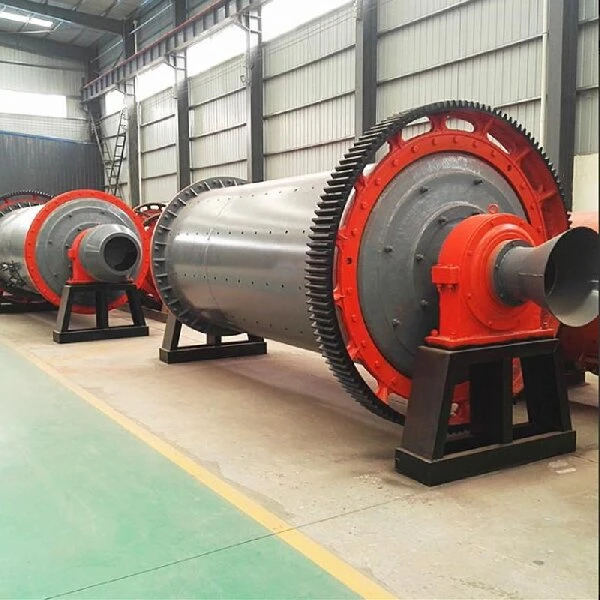


Product Description
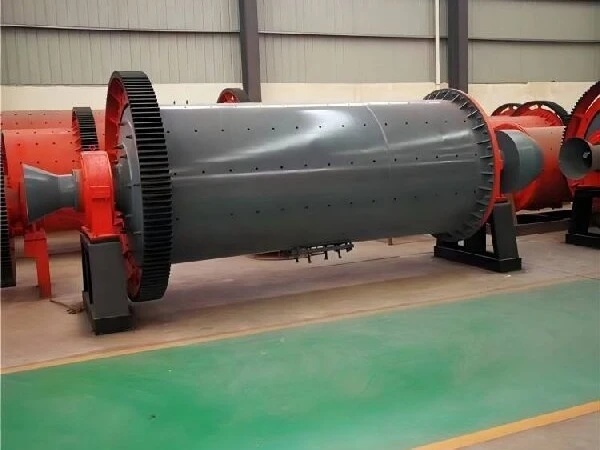
Ball Milling for Production Lines
An industrial ball mill carries out bulk grinding inside a horizontal steel drum. As the drum turns, the charge rises and falls against the feed. AGICO supplies mills for cement works, ore treatment and industrial mineral preparation. The choice between a dry mill and a wet mill follows the process that receives the ground material. The dry models listed here accept feed up to 20–25 mm and use drives rated from 18.5 to 4,500 kW. Selection also considers the equipment before and after the mill.
Product Advantages
Grinding Routes That Fit Production
Choose dry grinding when the following operation handles powder, or discuss a wet arrangement when the process handles slurry. The mill configuration follows that decision.
Replaceable Liners Protect the Shell
Liners form the working surface inside the drum. Worn sections can be replaced while the steel shell remains protected from direct contact with the charge.
Circuit Options for Product Control
The mill can discharge to the next operation in an open circuit. A closed arrangement adds classification and sends the coarse fraction back to the mill.
Engineering Support Beyond Equipment Supply
AGICO helps connect equipment selection with the plant flow sheet and installation plan. This lets buyers consider the grinding unit together with its surrounding equipment.
Grinding Process
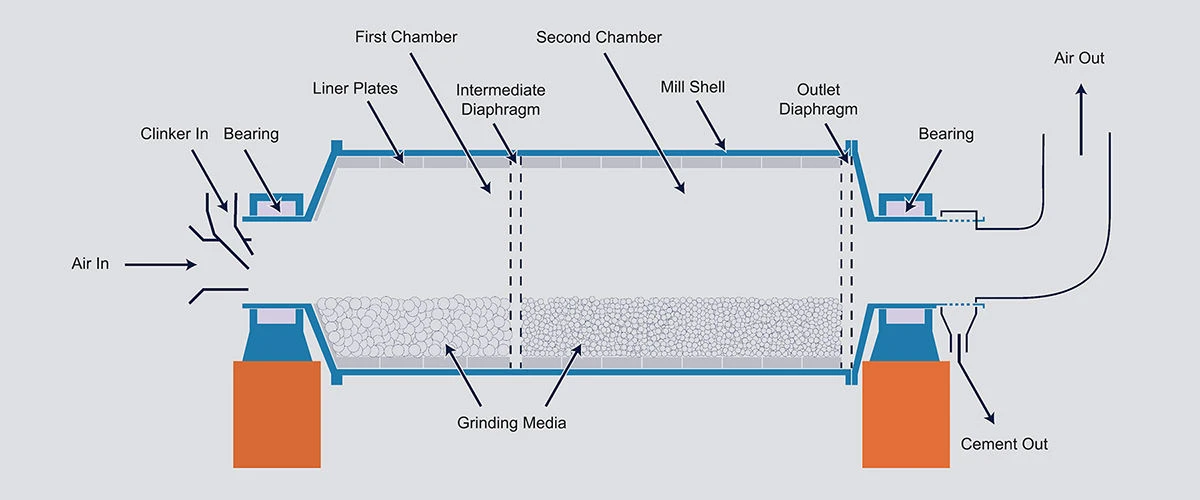
Two-chamber dry cement mill layout.
Feed and Grind
The rotating shell carries balls upward before they fall or roll across the feed. Repeated collisions and rubbing reduce the particles.
Move Through the Mill
In the illustrated dry cement arrangement, material passes through a diaphragm from the first chamber into the second for further size reduction.
Discharge and Classify
After discharge, a classifier separates the product in a closed grinding circuit. The oversize fraction returns for another pass through the mill.
Applications
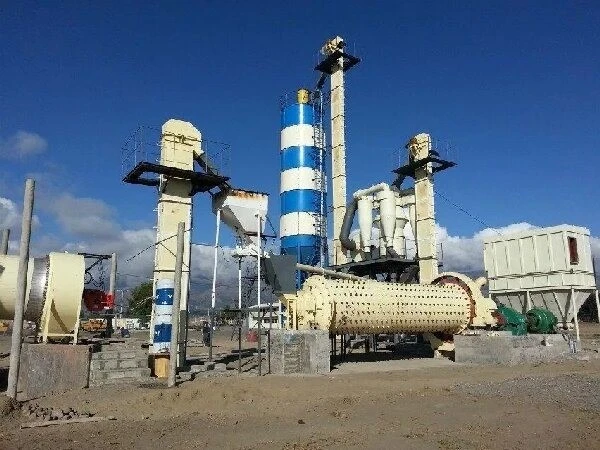
Cement Materials
Grinding clinker together with selected mineral additions prepares the powder used in cement production.
Mineral Processing
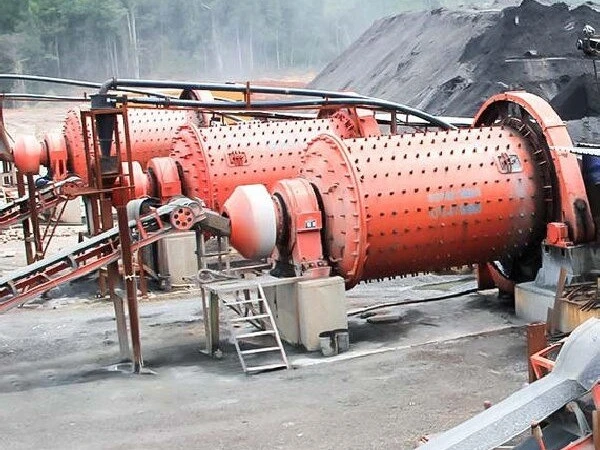
At an ore treatment plant, milling reduces particle size ahead of the separation stage.
Industrial Raw Materials
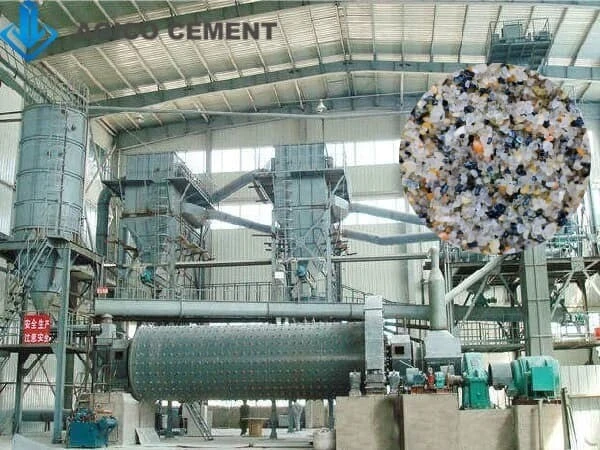
Mineral raw materials can be ground for refractory production and other manufacturing operations that require a prepared feed.
Hot Tags: industrial ball mill, China industrial ball mill manufacturers, factory, ball mill crusher, pyro ball mill, round rod milling machine, steel balls for ball mill, table top ball mill, trunnion ball mill
Technical Parameters
Dry Grinding Mill Specifications
| Mill spec. (mm) | Capacity (t/h) | Feed (mm) | Ball load (t) | Speed (r/min) | Power (kW) |
| φ900×1800 | 0.65–2 | ≤20 | 1.5 | 36 | 18.5 |
| φ900×3000 | 1.1–3.5 | ≤20 | 2.7 | 38 | 22 |
| φ1200×2400 | 1.5–4.8 | ≤25 | 3 | 36 | 30 |
| φ1200×4500 | 1.6–5.8 | ≤25 | 5 | 32.4 | 55 |
| φ1500×3000 | 2–5 | ≤25 | 7.5 | 29.7 | 75 |
| φ1500×5700 | 3.5–6 | ≤25 | 12 | 27 | 130 |
| φ1830×3000 | 4–10 | ≤25 | 11 | 25.4 | 130 |
| φ1830×6400 | 6.5–15 | ≤25 | 21 | 24.1 | 210 |
| φ2100×3000 | 6.5–36 | ≤25 | 15 | 23.7 | 155 |
| φ2100×7000 | 12–48 | ≤25 | 26 | 23.7 | 280 |
| φ2200×4500 | 9–45 | ≤25 | 27 | 21.5 | 280 |
| φ2200×6500 | 14–26 | ≤25 | 35 | 21.7 | 380 |
| φ2200×7000 | 15–28 | ≤25 | 35 | 21.7 | 380 |
| φ2200×7500 | 15–30 | ≤25 | 35 | 21.7 | 380 |
| φ2400×3000 | 7–50 | ≤25 | 23 | 21 | 245 |
| φ2700×4000 | 22–80 | ≤25 | 40 | 20.7 | 380 |
| φ2700×4500 | 26–90 | ≤25 | 48 | 20.7 | 480 |
| φ3600×8500 | 45.8–256 | ≤25 | 131 | 18 | 1800 |
| φ4000×6000 | 65–248 | ≤25 | 146 | 16.9 | 1600 |
| φ4500×6400 | 84–306 | ≤25 | 172 | 15.6 | 2000 |
| φ5030×8300 | 118–500 | ≤25 | 266 | 14.4 | 3300 |
| φ5500×8500 | 148–615 | ≤25 | 338 | 13.8 | 4500 |
Final specifications are tailored to your material, capacity, process, customization needs and site conditions. Contact our technical team to discuss your grinding project.
Selection Guide
Material and Feed
Provide material type, moisture and feed size.
Product and Output
Specify target fineness and required throughput.
Circuit and Site
Include process route, existing equipment, power supply and available space.
FAQ
Which production details should accompany a mill enquiry?
Start with the feed and the required finished product. Describe the material, its moisture and incoming particle sizes, then give the desired hourly tonnage and fineness. A flow sheet helps AGICO see where the mill belongs. For a replacement project, include drawings of the current installation.
What needs checking when replacing an existing mill?
The new unit must fit the rest of the line. AGICO reviews the available floor space, feed connections, classification equipment, discharge handling and electricity supply. Drawings and operating records help identify the interfaces before equipment selection proceeds. Access around the mill also matters for later service work.
Why is motor size insufficient for choosing a mill?
A motor rating identifies only one part of the machine. Useful comparison starts with the same feed material, finished particle size and production target. Check whether each offer includes the drive, liners, media and supporting equipment. Otherwise, two quotations may cover quite different grinding duties or supply scopes.
How is service access considered during project planning?
Leave practical access for inspections and liner changes when arranging the mill and nearby equipment. Discuss maintenance needs alongside the production schedule. AGICO can assist with installation guidance, commissioning, maintenance and spare parts, so these arrangements can be considered as part of the equipment proposal.


